



I have 3 strat type guitars and played acoustically they all sound differently. They all have a different degree of resonance and one sounds brighter overall than the others.
If I were to add anything to this thread I would say that it is the sum of all parts and the guitars action that defines the final sound output. Plugged in, I hear differences and that is when the electrical circuits take effect. Overall I think there are better guitars and the whole science of making better guitars has come together over many years and woods do make a tonal difference and I am convinced the matching of the neck and body wood in the first part of getting the tone right as well as the nut and bridge. We all have heard the way the bridge saddles alter the tone. The pressed steel strat saddles and the modern block type are two good examples where tone is affected.
So it really comes down to the whole design and components and the setup and yes I have heard strats that are much brighter than others and changing the neck has a notable effect on sound. So I believe the woods are the first step in getting a great guitar sound.
How about the Rosewood and Maple fretboard ? Anything in that ?
What guitar companies don't want you to know...
Re: What guitar companies don't want you to know...
 by roger bayliss » 15 Jan 2015, 14:45
American Pro Series Strat 2017, G&L S500 Natural Ash
-

roger bayliss - Posts: 1784
- Joined: 15 Sep 2009, 00:15
Re: What guitar companies don't want you to know...
by Gary Allen » 15 Jan 2015, 16:20
Spot On David...Let the scientists figure it out.David Martin wrote:Science is obviously a useful discipline, but it cannot, at any moment in time, satisfactorily explain everything... How do we know this? Because, every now and then, a scientist discovers something momentous and the laws of physics - or whatever - are rewritten...
So you can go on believing in whatever pleases you, science, sorcery or, indeed, tonewoods.
All I know is that my latest Les Paul R0 sounds and plays better than the one before it... And that an AC4 sounds better with Mullards than stock valves...
And what is "better"? Ask a believer in science... (And be prepared for the long haul...)
(For the sake of clarity - and peace and quiet - this was written tongue-in-cheek...)
-

Gary Allen - Posts: 710
- Joined: 15 Sep 2009, 13:39
Re: What guitar companies don't want you to know...
by dave robinson » 15 Jan 2015, 18:45
I've no intention of wasting my time listening to these people spouting. The facts for me are that I have experienced what is being discussed and heard the differences for myself, choosing instruments for their sound and for what I require, successfully having a pro career for almost fifty years and managing to get a good sound. The only time I didn't was when I stumbled across a handful of guitars during that long span and identified the problems with the poor tone. 90% of the problem was dead timber or the wrong timber. Amongst hose I remember most , I discovered two Fender Strats with dull sounding bodies as well as the Tokai Les Paul with a maple body that sounded pants. I moved all of those on and replaced them with new and normal service was resumed. It may not be the case every time but it did it for me. Also, there is a vast difference in sound between a maple, rosewood or ebony fretboard. You'd have to be a lost case not to hear that.
Dave Robinson
-

dave robinson - Posts: 5274
- Joined: 09 Sep 2009, 14:34
- Location: Sheffield
Re: What guitar companies don't want you to know...
by bor64 » 15 Jan 2015, 19:19
I'm with Dave on this.....I handled so many guitars I lost count.....dozens and dozens pre cbs, more then 25 original Marvin's to name a few types...
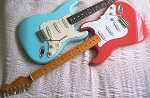
On top of that I've 2 exactly the same guitars(except colour) both 1960 slabboard strats , one sounds very warm and the other sounds very bell like....
The warm sounding one is just under 100 gram heavier and Daphne Blue, the other one is Fiesta Red.....so if that geezer is right they have to sound the same....
It must be the colour then??
Cheers Rob
On top of that I've 2 exactly the same guitars(except colour) both 1960 slabboard strats , one sounds very warm and the other sounds very bell like....
The warm sounding one is just under 100 gram heavier and Daphne Blue, the other one is Fiesta Red.....so if that geezer is right they have to sound the same....
It must be the colour then??
Cheers Rob
- bor64
Re: What guitar companies don't want you to know...
by Uncle Fiesta » 15 Jan 2015, 21:03
As Leonard would say, here we go.
How do you know the two guitars are absolutely identical? Have you measured every dimension, every component, the values of all the pots and caps? What about the fit of the neck to body join, fit of the bridge, depth of the nut slot, strings? And yet you still believe any differences in sound are down to the wood, and the wood only.
You don't think the world's flat as well do you?
How do you know the two guitars are absolutely identical? Have you measured every dimension, every component, the values of all the pots and caps? What about the fit of the neck to body join, fit of the bridge, depth of the nut slot, strings? And yet you still believe any differences in sound are down to the wood, and the wood only.
You don't think the world's flat as well do you?
-
Uncle Fiesta - Posts: 1148
- Joined: 27 Apr 2012, 23:31
- Location: near Gainsborough, England

Re: What guitar companies don't want you to know...
by bor64 » 16 Jan 2015, 14:27
Steve, Nowhere I'm stating that the wood alone is a sound signature shaping factor on it own.....
Yes Steve as a Fender nutcase I've measured every little detail you can imagine on the two gits...that's why I know there is just less then 100 gram between gits...
Yes I know both setups are the same because I did it myself as with my other 30+ guitars....and 100's of others....
All electrical components where so close in spec that only two decimal places you cold read the difference.....
15 years ago I exchanged (and swabbed back) the plates and guess what? That significant sound difference staid with the guitar, not with the pick guards!!!!!
I believe also that electrics and hardware with significant different specs and designs can made a difference also....
But I believe that parts made by nature and therefore at 99.9999999 % of the time have a different composition make more difference in the way a instrument feels and sounds in comparing with manmade iron-plastic-copper etc. made most of the time in spec without a large difference of % specs.....
Wot? Is the earth not flat?..... wow.....
  well do you know the sun turns around this pancake?
Yes Steve as a Fender nutcase I've measured every little detail you can imagine on the two gits...that's why I know there is just less then 100 gram between gits...
Yes I know both setups are the same because I did it myself as with my other 30+ guitars....and 100's of others....
All electrical components where so close in spec that only two decimal places you cold read the difference.....
15 years ago I exchanged (and swabbed back) the plates and guess what? That significant sound difference staid with the guitar, not with the pick guards!!!!!
I believe also that electrics and hardware with significant different specs and designs can made a difference also....
But I believe that parts made by nature and therefore at 99.9999999 % of the time have a different composition make more difference in the way a instrument feels and sounds in comparing with manmade iron-plastic-copper etc. made most of the time in spec without a large difference of % specs.....
Wot?
Is the earth not flat?..... wow..... well do you know the sun turns around this pancake? - bor64
Re: What guitar companies don't want you to know...
by stephen » 16 Jan 2015, 16:01
Uncle Fiesta wrote:Good post Stephen and everything you say is historically verifiable. I had indeed come across the pine story quite recently so it's still fresh in the mind. I think it's significant that the person who designed the thing in the first place didn't care which wood was used to make it. Furthermore the change back to ash was only because solid colours were going out of fashion and sunburst and natural were coming back, and the grain pattern of ash made for a nicer appearance. The subsequent change back to alder was driven by comments from dealers and customers that the bodies were becoming too heavy.
I'm not saying that the vibration of the wood doesn't affect the vibration of the strings, I'm just saying that if it does, there is no scientific evidence that different woods will affect it differently. And even if they do, I doubt it would be detectable compared with other inevitable differences between any two guitars such as construction, hardware, pickups, and, as Martin just said, the player.
In other words you can't just point to two guitars and say, these sound different because of the wood. There will be many other factors at work.
Glad that you found my post interesting, Steve. I was really intrigued by those facts when I initially came across them and since then, have seen them cross-referenced by several other respected Fender historians who'd interviewed Leo, George Fullerton, Freddie Tavares, Forrest White & others, regarding how the choice of body woods came about. I thought that it made a valid & interesting counter-point to the current thread regarding 'tone woods'. They are neither my views nor opinions, I'm just recounting documented, historical Fender facts........
Just thought that I would share these perhaps not that well-known details with people that due to the Shadows connection on this site, have an inherent interest in 1950's/'60's era Fender guitars and the (possibly?) surprising factors that contributed to the selection of woods. I haven't read anywhere that the subject of 'tone' in relation to the type of wood, was a consideration and in that regard, Leo relied on constant feedback from the top, pro. players in southern California in order to develop the products that the working musician wanted.
Stephen.
- stephen
Re: What guitar companies don't want you to know...
by stephen » 16 Jan 2015, 16:08
Gary Allen wrote::lol:
Love that, Gary & well-spotted! Nothing wrong with the sound of the slide guitar either. Looking at these it struck me as a project that Ecca might well embark on.
Stephen.
- stephen
Who is online
Users browsing this forum: No registered users and 33 guests
These advertisements are selected and placed by Google to assist with the cost of site maintenance.
ShadowMusic is not responsible for the content of external advertisements.