



Hi
iam after some advice concerning putting a clear laquer coat over a Headstock decal
Should i use cellulose or acrylic laquer ?
regards
Jay
Advice on types of laquer
11 posts
• Page 1 of 2 • 1, 2
Advice on types of laquer
 by Jay Bass » 02 Jan 2015, 19:54
Last edited by Jay Bass on 02 Jan 2015, 21:12, edited 1 time in total.
-
Jay Bass - Posts: 876
- Joined: 16 Sep 2009, 18:10
- Location: Cambridgeshire UK
Re: Advice on types of laquer
by Gary Allen » 02 Jan 2015, 20:02
Hi Jay, acrylic is safer and shinier, gary
-

Gary Allen - Posts: 710
- Joined: 15 Sep 2009, 13:39
Re: Advice on types of laquer
by Billyboygretsch » 02 Jan 2015, 22:14
I would use acrylic as safer and easier.Cellulose is a great finish but can be difficult to use and you must use correct procedures. Not sure acrylic is glossier unless you have the right equipment.
Cellulose needs good drying conditions or can bloom or even crack. I have this problem with a current project.
What project are you doing ?
Cellulose needs good drying conditions or can bloom or even crack. I have this problem with a current project.
What project are you doing ?
- Billyboygretsch
- Posts: 1030
- Joined: 14 Nov 2012, 21:15
- Location: Bedfordshire
Re: Advice on types of laquer
by Billyboygretsch » 02 Jan 2015, 22:17
You also need to check what your base coat is. As I understand you can put cellulose over acrylic and not the other way round. Don't take my word for it but please check that detail before proceeding
- Billyboygretsch
- Posts: 1030
- Joined: 14 Nov 2012, 21:15
- Location: Bedfordshire
Re: Advice on types of laquer
by Jay Bass » 02 Jan 2015, 23:25
Thanks for the info
i have a fender telecaster Bass with a replacement neck
The Replacement logo has been applied it just needs a coat of laquer to finish it off
as far as i am aware the headstock hasnt any paint or laquer on it at all at the moment.
regards
jay
i have a fender telecaster Bass with a replacement neck
The Replacement logo has been applied it just needs a coat of laquer to finish it off
as far as i am aware the headstock hasnt any paint or laquer on it at all at the moment.
regards
jay
-
Jay Bass - Posts: 876
- Joined: 16 Sep 2009, 18:10
- Location: Cambridgeshire UK
Re: Advice on types of laquer
by Derek Misselbrook » 02 Jan 2015, 23:36
Acrylic is the safest to use, but put only a dust coat over and let nearly dry, don't worry about orange peel that can be sorted later.....Build up coats very slowly, make sure lacquer can is warm or it will spurt out, shake well before you start, they say all the time you can smell the paint it's not dry, six weeks it takes to fully cure but after four weeks block it back with 2000 grit wet and dry using soapy water to stop clogging on paper , Finnish with a good wax well rubbed as if you were using T Cut............The idea is not to see the edges of the decal..... 
Derek W Misselbrook.
-

Derek Misselbrook - Posts: 247
- Joined: 30 Jan 2011, 15:53
- Location: HAMPSHIRE
Re: Advice on types of laquer
by Gary Allen » 03 Jan 2015, 14:01
 709168.jpg
- (11.38 KiB) Downloaded 6087 times
-
Gary Allen - Posts: 710
- Joined: 15 Sep 2009, 13:39
Re: Advice on types of laquer
by Uncle Fiesta » 13 Jan 2015, 00:53
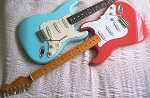
When I apply a headstock decal I coat it with Tamiya Clear Acrylic, the one model builders use. It's number X-22 in their range and won't attack anything.
You can thin it and spray it if you want to (I think they do it in spray cans also) but I don't bother. I just brush it on because it's going to be rubbed down anyway. Each coat only takes about an hour to dry so it's quite quick.
Have a look at my 70's Strat if you don't believe me.
You can thin it and spray it if you want to (I think they do it in spray cans also) but I don't bother. I just brush it on because it's going to be rubbed down anyway. Each coat only takes about an hour to dry so it's quite quick.
Have a look at my 70's Strat if you don't believe me.
- 70StratRed_3.JPG
- (740.27 KiB) Downloaded 5982 times
-
Uncle Fiesta - Posts: 1148
- Joined: 27 Apr 2012, 23:31
- Location: near Gainsborough, England
Re: Advice on types of laquer
by Billyboygretsch » 13 Jan 2015, 23:22
You sure you didn't use black paint lol
- Billyboygretsch
- Posts: 1030
- Joined: 14 Nov 2012, 21:15
- Location: Bedfordshire
Re: Advice on types of laquer
by Graylion » 14 Jan 2015, 16:18
You guys need to have experience respraying cars and bikes! Acrylic can go onto just about any basecoat but cellulose can't. It will act as a paint stripper on many finishes. Even Burns was using acrylic/non-cellulose paint in the early 1960s so beware. Car makers stopped using cellulose in the late 1960s/early 1970s but paintshops still used it (still do!) as it's easier and more forgiving than other paints. It doesn' matter if it blooms or get squashed flies on a layer - just overspary it with another thin coat. You need at least 6 anyway! The consensus that acrylic should be used is correct. The last coat of refinishing for any paintwork should be flatted with 1000 or 1200 Grade wet & dry used wet, then a good quality polish - cars, bike or guitars! This gets rid of any minor dimpling or 'orange-peel' effect.
- Graylion
11 posts
• Page 1 of 2 • 1, 2
Who is online
Users browsing this forum: No registered users and 25 guests
These advertisements are selected and placed by Google to assist with the cost of site maintenance.
ShadowMusic is not responsible for the content of external advertisements.